Showing posts with label students. Show all posts
Showing posts with label students. Show all posts
Friday, 23 May 2014
Visualising the field - VR and mobile devices
A recent workshop presented by Scott Turner, Naomi Holmes, Adel Gordon and Janet Jackson at Northampton Learning and Teaching Conference 2014- Northampton 2018: Planning, Designing and Delivering Student Success gave participants an opportunity to 'play with' some of the computing technologies they have been investigating as tools for Environmental and Geography Students.


Learning Across Contexts
A recent paper presented by Naomi Holmes and Adel Gordon at Northampton Learning and Teaching Conference 2014- Northampton 2018: Planning, Designing and Delivering Student Success discussed some of the technologies they have been investigating as tools for Environmental and Geography Students.
Thursday, 22 August 2013
Sixth Form students working with professional scientists at the University of Northampton
Taken from: http://www.northampton.ac.uk/news/sixth-form-students-spend-their-summer-holidays-working-with-professional-scientists-at-the-university-of-northampton
Sixth Form students spend their summer holidays working with professional scientists at the University of Northampton
- Thursday 22nd August 2013Sixth Form students have had the opportunity to work alongside professional scientists at the University of Northampton on a research project as part of the Nuffield Research Placements programme.The six students were from schools across the county and spent six weeks at the University’s School of Science and Technology, gaining hands-on experience and a valuable insight into a professional research environment. The University has been actively involved with this programme for several years and it is part of the School of Science and Technology’s larger commitment to outreach.The participants included Sheldon Kawonga from Kettering Science Academy, Emmanuel Hlouverakis and Hafiz Alaraf both from The Duston School, Agota Geciauskaite from Malcolm Arnold Academy, James Adams from The Northampton Academy and Phillipa Hawkley from Brooke Weston Academy. All were invited to give presentations on their individual projects, which varied from building a mobile device app to investigating the sensitivity of magnetic particle inspection technique.Nuffield Research Placements provides 1,000 students each year with the opportunity to work alongside professionals in the Science, Technology, Engineering and Maths (STEM) sector. The programme is open to students on the first year of a post-16 STEM course and placements are available across the UK in universities, commercial companies, voluntary organisations and research institutions.One of the students, Phillipa Hawkley, said: “I found this experience to be really good as we got to use facilities that we don’t have at school and the chance to use this software puts us above others our age and will really help with university applications.”James Adams said: “It’s been a good experience, especially from a software developer’s point of view, as I’ve never had the experience of developing something based on someone else’s specifications.”Dr Abdeldjalil Bennecer, Senior Lecturer in Engineering at the University of Northampton commented: “The sixth form students are about to enter the second year of their A-levels and have spent six weeks over the summer with us working on individual projects.We held interviews with each student and the ones we offered places to were the brightest in their class and expressed an interest in STEM subjects at university level. We tailored the project briefs to suit their interests.It's been a beneficial few weeks for these students and we have thoroughly enjoyed working with them and giving them the ultimate experience of working with professional scientists."

Monday, 8 April 2013
Novel Teaching: University to create MMOG with students
Taken from: http://computingnorthampton.blogspot.co.uk/2013/03/university-of-northampton-to-create.html
 BSc Computer Games Development lead by Martyn Simmons is the focus of an article by the Magazine EDGE about plans to develop a massively multiplayer game ( MMOG) with the students. The MMOG is just one of the aspects considered, a game involving Stoke Bruene Canal is discussed as is the Games courses multidisciplinary nature.
BSc Computer Games Development
HND Computer Games Development
Also mentioned in the article is NVision and the advantages of having on-site immersive environment equipment.
For more details see: University of Northampton to create MMOG with students
The article can be found at: http://www.edge-online.com/get-into-games/university-of-northampton-to-create-mmog-with-students/2/

BSc Computer Games Development
HND Computer Games Development
Also mentioned in the article is NVision and the advantages of having on-site immersive environment equipment.
For more details see: University of Northampton to create MMOG with students
The article can be found at: http://www.edge-online.com/get-into-games/university-of-northampton-to-create-mmog-with-students/2/
Friday, 22 February 2013
Rubbish – Reduce, Reuse, Recycle into toys!
Taken directly from http://lab13network.wordpress.com/2013/02/22/rubbish-reduce-reuse-recycle-into-toys/ Rubbish – Reduce, Reuse, Recycle into toys! Lab13 at Irchester (@Lab_13Irchester)


Waleed and Jacob searching for goodies!
Year 5 students at Irchester have been working on a very exciting project with the Dept. of Waste Management, University of Northampton. Dr. Waleed Montasser and Louise Maxwell, and Bianca, Evie and Livia (Brazilian visiting students) work alongside our Year 5s to design, plan, resource and make different Science Takeaways all using reusable and recycled materials.
Science Takeaways will be a set of four science kits with different experiments for children to borrow for the weekend and try at home. They will collect data or test hypotheses and add to the kit if they think of some new way of using it.
However, we wanted to keep these takeaways as reusable and “green” as possible and didn’t want to spend a lot of money making them! Waleed had the great idea of using Phoenix Resource Centre in Raunds.
They collect clean usable waste (including off-cuts of material, wood, card), surplus stocks, end of lines and unwanted goods / returns from industry and local businesses. Anything that can be re-used then gets put onto shelves for people to reuse. As you can see we did a great job of finding just the right things we needed!
Today, we have visited the site for the first time to collect and resource our projects. It was a freezing but really cool place and John on of the trustees helped us fill our trolleys! What they are doing there is very good for the environment even the actor who plays Ron Weasly think so and have visited them!
Today, we have visited the site for the first time to collect and resource our projects. It was a freezing but really cool place and John on of the trustees helped us fill our trolleys! What they are doing there is very good for the environment even the actor who plays Ron Weasly think so and have visited them!
Aimee and Livia are happy with what they have found!Aimee, age 9, says “I think that this is a good place because it stops all the materials from going into landfill. It makes people reduce waste and reuse things so that we can have a nice county instead of a big smelly dump in the ground!

Saturday, 2 February 2013
How do students use technology after graduating ?
Introduction and Overview
Transition Out (TO?) was a six month intensive investigation (Jan – June 2012) funded as part of the URB@N project looking at how students want to use (or are already using) technology which will assist as they look towards completing their course and moving into employment or other future opportunities. This could be any type of technology ranging from mobile devices, social networking and cloud services. Students may not realise that the activities they are doing will assist with their transitions – they might be actively collaborating with peers (Ellison et al, 2007), using time management or planning tools, or generally enhancing their skills and experience using a range of technology. The work builds from the LLIDA (JISC, 2009) and SLiDA (JISC, 2010) investigation of supporting learners in a digital age.
Key Results (n=214)
•Word processing (85%) and email (88%) are the most popular technologies to support students as they leave the institution.
•Students under the age of 30 are more likely to use technology than those over this age (sig < 0.05)
•Males are tending to use technology to find future opportunities more than females (sig <0 .05="" div="">
•66% had suffered from a lack of knowledge / confidence with the use of technology, however 22% would not seek out resources supplied by the University to help them improve their skills
.
5 Key Messages For Students
1.Lock down your Facebook and Twitter accounts! Employers will search for you, make sure they can only see what you want them to – privacy settings are a must!
2.Get into Social Media – Open a LinkedIn Account and professionalise your Facebook! This is the ‘new’ job search, and it works!
3.Use the support services whilst you are here, have a problem with psychometric testing or need help on time management / planning ? Go and see Careers
4.Consider which email address you use to contact employers – KittyKatLOL@me.com is not going to give the best first impression!
5.Make use of MyPad or alternative portfolio system! Employers want evidence of your experience, and this is a great way to document what you do, as you do it, to then include in your CV. If you go on a placement this is a tool which could help you to make the most of your experience.
.
Conclusion
From the data which has been gathered so far, teams which support students (e.g. Careers and Library) will be able to refine their support, engagement and provision. Those involved in the development and running of courses will be provided with further guidance and support to consider how development of the digital literacy of the cohort will impact on their ability to gain future opportunities on leaving. Provision should be integrated into the student experience rather than being seen as a bolt-on.
Resource Links
PDF of presentation made at Employer Engagement in a Digital Age – 4th July 2012 (University of Greenwich)
References
Ellison, N. B., Steinfield, C., Lampe, C. (2007), The Benefits of Facebook “Friends:” Social Capital and College Students’ Use of Online Social Network Sites. Available from:http://onlinelibrary.wiley.com/doi/10.1111/j.1083-6101.2007.00367.x/full [Accessed 30th March, 2012]
JISC (2009), Learning Literacies in a Digital Age [online]. Available from:http://www.jisc.ac.uk/whatwedo/projects/elearningllida.aspx [Accessed 30th March, 2012]
JISC (2009), Study of how UK FE and HE institutions are supporting effective learners in a digital age [online]. Available from:http://www.jisc.ac.uk/whatwedo/programmes/elearning/slida.aspx [Accessed 30th March, 2012]
Rossi, N. (2011), Social Networking: Professional standards and boundaries must be maintained when you are online. Available from: http://www.nmc-uk.org/Documents/NMC-Review/NMCReview_issue4.pdf Page 8. [Accessed 30th March, 2012].
Project Team:
Rob Howe and Penelope Stanton
Further details:
Monday, 23 April 2012
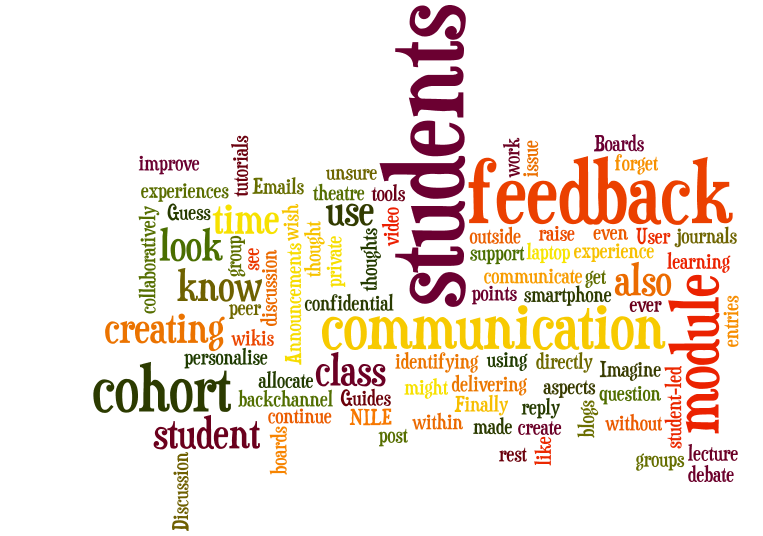
Feedback and Communicating with students.
Re-posted from: http://blogs.northampton.ac.uk/learntech/2012/03/15/feedback-and-communicating-with-students/
Guess you know you can issue Announcements and Emails through your NILE module directly to your students, but ever thought about using student-led communication tools like Discussion Boards, to continue communication and debate, and get feedback from your students outside of class time?
You might also know that by creating groups of students in your module, you can allocate them their own discussion boards, blogs and wikis to work on collaboratively. But don’t forget you can also use these for peer support, and for delivering group feedback. Imagine how it would improve communication and feedback within the module cohort.
Finally, you can personalise the student learning experience by creating private journals for students to post their thoughts, feedback and experiences. Only you can see their entries and reply to them if you wish. You can even use this to create a confidential ‘backchannel’ in the lecture theatre – if students are unsure on any of the points you’ve made, they can raise a question from their laptop or smartphone without identifying themselves to the rest of the cohort.
Have a look at these video tutorials and User Guides to look into these aspects more.
To comment on this posting go to: http://blogs.northampton.ac.uk/learntech/2012/03/15/feedback-and-communicating-with-students/
For this and other postings on Learning Technologies go to: http://blogs.northampton.ac.uk/learntech/
For this and other postings on Learning Technologies go to: http://blogs.northampton.ac.uk/learntech/
Friday, 3 February 2012
waste as tool to inspire students into computing

A recent article in the Northampton Herald and Post " How a university is using waste as tool to inspire students " by Lawrence John discusses the Junkbots project.
"FUNNY
looking robots called junkbots could be the key to encouraging more
children across the county to become engineers, computer programmers or
scientists.
One force which is driving this idea forward is the University of Northampton.
For
the past few years, staff from its science and technology department
have been going out to primary and secondary schools to spread the word
that science is fun.
By
working with schools, the university hopes to show pupils a different
side to computing and hopefully raise their interest in what they can
achieve" Lawrence JohnWednesday, 19 October 2011
Double the Teaching Fellows!
The School of Science and Technology is going to double the number of Teaching Fellows to six (joining Jonathan Adams, Greg Spellman and Scott Turner). Three colleagues were successful in their application for Teaching Fellowship (one of only four to be awarded).
Ruth Copeland-Philips, Louise Maxwell and Paul Cox will be awarded their fellowships for their work on Technology to help with the transistion into Higher Education of distance learning students.
Details of their work can be found at:
- The University of Northampton Teaching
and Learning Conference (May 2009), Piloting
Induction Strategies for Distance Learners. Poster presentation and
conference paper.
- The University of Northampton Teaching and Learning Conference (May 2011) Technology Enhanced Transition Programme for Distance Learners, Poster presentation
- Widening Participation Seminar at The University of Northampton, (September 2011), Technology Enhanced Transition Programme for Distance Learners, Poster presentation and conference paper.
- Poster
presentation available in Park Library atrium (24th October - 4th
November 2011) .
- Widening
participation web pages: http://www.northampton.ac.uk/info/200284/widening-participation/1132/projects
- School of Science and Technology blog (18 September 2011) Technology Enhanced Transition Programme:http://apslandt.blogspot.com/


Wednesday, 15 June 2011
Influencing students’ construction of personalised concept maps
 Details of a poster presented at the recent Learning Global conference , University of Northampton
Tuesday, 15 June 2010
Learning for Sustainable Developments
The United Nations declared 2005-2014 the Decade of Education for Sustainable Development (ESD) "Education in general has been affected by the multiple crisis – not only in terms of threats to budgets, aid flows and learning opportunities, but also in terms of the very purposes of education: what kind of society and economy, indeed what kind of future should education prepare learners for? And how should it respond to the changing realities around us as well as prepare for – and contribute to – a different future? These types of questions have long been important components of Education for Sustainable Development (ESD), but have now, in 2010, acquired new urgency and relevance. " UNESCO (2010)
Two Geography senior lecturers from the University, one of whom Dr Greg Spellman is from the School of Science and Technology, along with Dr Faith Tucker (School of Social Sciences) have developed a level 4 module called 'Learning for Sustainable Development'. This has involved a range of innovative methods.such as:
UNESCO (2010) "UNESCO Strategy for the Second Half of the United Nations Decade of Education for Sustainable Development" [internet] :Paris:UNESCO (Published 2010) Available at: http://unesdoc.unesco.org/images/0018/001873/187305e.pdf
Two Geography senior lecturers from the University, one of whom Dr Greg Spellman is from the School of Science and Technology, along with Dr Faith Tucker (School of Social Sciences) have developed a level 4 module called 'Learning for Sustainable Development'. This has involved a range of innovative methods.such as:
- UN style role-playing
- Producing a video documentary on a sustainability research project.
- Blogs to enable students to think about sustainability in their daily lives.
Spin-offs from this include a project working with a northamptonshire school on sustainability, fitting with the other projects involving sustainability and school's (e.g. Junkbots) that are on going within the School of Science and Technology.
UNESCO (2010) "UNESCO Strategy for the Second Half of the United Nations Decade of Education for Sustainable Development" [internet] :Paris:UNESCO (Published 2010) Available at: http://unesdoc.unesco.org/images/0018/001873/187305e.pdf
Subscribe to:
Posts (Atom)